Our Loss of Physical Connection to Music
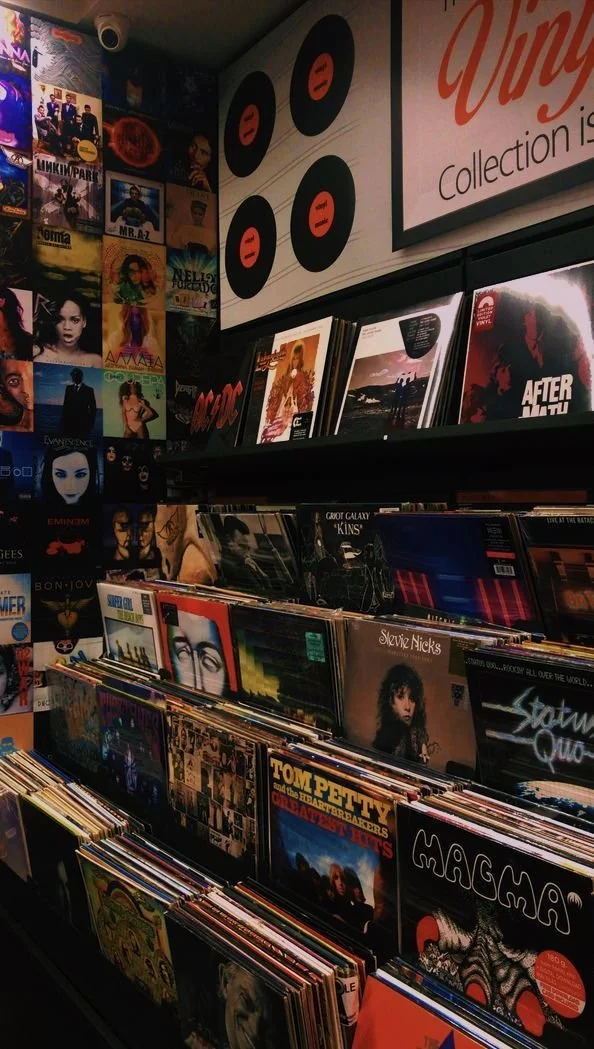
Photo via Pinterest
During a random Saturday afternoon Instagram doom scroll, I happened to come across a post by an account named @joshpsychology about the need for a return to analogue culture. The part that stuck with me was when he wrote, ‘the simple joys of tangible living are irreplaceable and can never be taken away from us. No screen can replicate the weight of a book in your hands, the warmth of someone’s voice without lag, or the way time slows when you are fully present.’ This made me put my phone down, and I thought about it for a few moments. He was, in many ways, right; over the years there had been a change in my relationship to physical media; yet all the things that made me, me, were mostly physical; my book collection, the posters of my artists, my journals that I’d written over the years, documenting my youth, all of these things were of high sentimental value to me, as they are to so many of us.
Yet so much of our identities has been digitalised and put into non-physical intangible clouds, and nowhere is this more evident in music. While my parents used to use a CD player when I was a child, now all it takes is one search on YouTube, and they’ve found several songs to listen to. The record player (though making a comeback) is no longer a staple of fun parties with friends. You certainly won’t catch a lover serenading you outside your window with a boombox these days. It seems, as we carry our devices all the time, with Spotify, Apple Music, and YouTube all at our fingertips, too much of our personal identities exist behind our screens.
And I understand it, I really do. As a girl from Generation Z, I cannot imagine not being able to access a song or an album instantaneously, or seeing footage of a concert on TikTok, even if I wasn’t able to attend. Certainly, there’s risk with CDs and DVD players; they can break, they can get lost, they can be damaged, and companies are slowly phasing out technology compatible with older media (LG announced they’ll stop making new Blu-Ray players), meaning sometimes we genuinely cannot use those forms of media. We have little choice but to pay streaming services an ever-increasing amount to listen to songs that are mostly four minutes or shorter. We no longer own our music, whether it be slightly scratched vinyls or a randomly curated selection of CDs, but instead we have given our ownership to big tech and online servers. What we think belongs to us is nothing more than an indefinite rental, making our connection to the music that moves us more unstable than ever.
This harms both the consumer and the artist: we can access any song or any snippet at any time. Most of the time, people don’t listen to full albums anymore; instead, they simply replay their favourite songs back to back, rather than listening to the entire CD or vinyl. The essence of the project that the artist intended is lost. It could be said that we hear the artists we listen to, but we no longer get the chance to listen to and understand the entirety of their work in the way it was intentionally curated through bodies of work.
Short-form media has worsened this. Nowadays, I can hardly sit through anything longer than a twenty-second reel or video before scrolling away impatiently. Songs go viral on social media these days for how likable they are in an extremely short time frame. The audience latches onto that one part and even dismisses the rest that they don’t deem ‘trendy’. This poses the question: Is artistry itself changing for the worse? How can artists grow and develop beyond one-second wonders if it is no longer deemed valuable by their audience and mediocrity is encouraged instead?
The solution? Conscious effort to reclaim our physical relationship to music. Not in a materialistic way, but because in twenty, even ten years, when most things are digitalised, I’m sure we’d all like to look fondly over the CDs we love the most and be able to call them ours, present with us throughout every stage of life, and see the age and wear not as a disadvantage, but as a sign that our music has grown and aged with us, and can be given to our children, our friends, our communities, living testaments that we were here, and we enjoyed and loved.