When in Doubt, Sing.
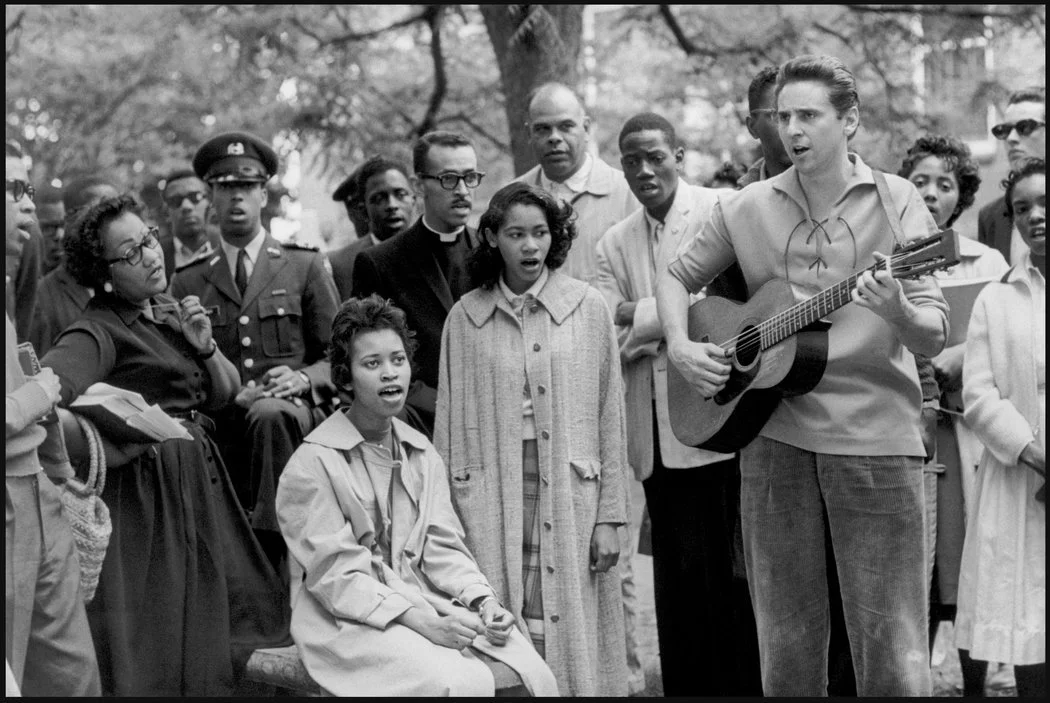
Eve Arnold/Magnum Photos, via The New York Times
Music has long been used to communicate. Ballads of love and loss have joined people together since the dawn of time. Melodies have provided community, comfort, and unity in some of the darkest moments. When looking at “unity” in song, one could think of centuries-old battle chants, religious hymns, or folk tunes. What they all tend to have in common is a quelling of fear–to unite those of a particular group, ideology, or culture with a concerted goal through song. It is evident that in times of strife, art brings humanity together. Creation sparks movements, and more often than not, a great deal of change can emerge from just a single chorus.
Music as a form of protest: A practice that has never gone out of style. Around the world, many a revolution has been accompanied by the swell of voices singing for freedom. It is no different in the United States. Many of the “all-American” songs played on the Fourth of July originated on the battlefields of the Revolutionary War. “The Star-Spangled Banner” was first a poem, written after British forces attacked a military base in Baltimore, Maryland. More often referred to as “Ants Go Marching,” the Civil War song “When Johnny Comes Marching Home” was written by a Union band leader in response to seeing citizens long for the war to end so they could reunite with their loved ones. During this same period, countless songs surrounded the movement to abolish slavery. “Sometimes I Feel Like a Motherless Child” and “Oh, Freedom” are two of the many works that gained recognition during the time and were later used during the Civil Rights Movement.
Though the previous pieces emerged from the effects of war and turmoil on United States soil, this did not mean that music no longer held its place in national demonstrations and culture. Throughout the twentieth century, as radios and records became more prominent and developed sources of listening, musical movements became even larger. “Boogie Woogie Bugle Boy,” famously recorded by the Andrews Sisters, tells the story of a trumpet player who is drafted, yet finds joy when given the chance to play his own music for fellow soldiers. The English Vera Lynn’s “We’ll Meet Again” became an international sensation. The song depicted the struggle of saying goodbye to deployed loved ones, while also attempting to remain content with the promise of meeting again once the war ended. This was an era of utilizing music as a form of hope, and as a response to the rapid changes–both technologically and politically–being witnessed across the globe.
In the decades following the World Wars, a shift emerged in how people used music to react to politics and culture. Whereas the previous examples tended to focus more heavily on the idea of emboldening a growing nation and supporting the country in its endeavors, the sixties and seventies ushered in an “anti-establishment” theme within music. This was a period that encompassed the Civil Rights Movement, the Vietnam War, the Equal Rights Amendment, and an abundance of other fights for social change. Citizens began to take to the streets and sing for change. “Ohio” by Crosby, Stills, Nash & Young was a reaction to the Kent State Massacre. Creedence Clearwater Revival's “Fortunate Son” became an anthem for growing opposition towards the Vietnam War. The counterculture was alive and well, and Americans were using music as a tactic to protest against their own government, not support it.
Now, in the twenty-first century, it cannot be denied that the United States is anything but “united”. This then begs the question: where has the protest music gone? Surely, in a time of such polarization and political upset, we would see the same pattern play out as it always has? The number one songs on the radio might tell the stories of a nation divided, and spotlights given to the artists who decide to sing out and speak out–non-performatively, I might add. Well, the genre does still exist, but the number of songs that receive major attention seems to be increasingly waning, especially compared to that of protest music in the last fifty years. Still, there are several artists who have stood out when considering political activism and engagement.
Bad Bunny–who recently became the first musician to win the Album of the Year Grammy with an all-Spanish-language album–has been incredibly open about his anti-ICE stance and his dedication to his culture. In a New York Times interview, he stated, “Sometimes you want to cry, sometimes you want to dance, sometimes you want to fall in love, and sometimes you want to talk about political things.” Bruce Springsteen recently released “Streets of Minneapolis”, a tribute and response to the ongoing ICE raids and violence taking place in the Minnesota city. “I wrote this song on Saturday, recorded it yesterday, and released it to you today in response to the state terror being visited on the city of Minneapolis,” Springsteen said in an Instagram statement. These are just two examples of artists whose music and careers are not only dedicated to a certain sound or topping charts, but also to being a voice for a nation and people who do not have as large a platform.
Despite the fact that there are several high-profile artists using their voices and artistry to speak up, there is perhaps a greater issue that unfortunately outshines some of that great work. The music industry, in a capitalistic sense, has forgotten the root of what creation means and what it can evoke. So many underground artists dedicate entire albums to current events and the fractured country in which they live, yet they seldom get the recognition for it. Scroll on TikTok for a while, or go on your streaming service of choice, and you will find them. A personal favorite of mine is Gabrielle Hope’s “dirt so cheap”, an anti-capitalist folk piece that explores the struggles of the working-class, and how the system does nothing to help those who need it most. Listen to the music that has shaped movements, cultures, and forged paths with a single lyric. Find an artist who calls out to what you stand for.
“It’s time we stop
Hey, what’s that sound?
Everybody look, what’s going down?”
–“For What It’s Worth”, Buffalo Springfield, 1966